
Introduction: On the tracks of the Hanoi Light Rail in Vietnam and the Sydney Metro in Australia, China’s rail transit signaling system is earning international trust through its proprietary technology—a strategic shift from “product export” to “brand symbiosis.”
Against the backdrop of profound changes in technology, markets, society, and the international environment, how to reread Drucker and apply his management principles in a contemporary context—particularly by grasping his strategic discourse and reshaping the “soul of strategy” of an enterprise—has become a core topic of concern for many managers. On April 11, 2026, the National School of Development at Peking University, in partnership with China Machine Press, hosted the 52nd Chengze Business Forum under the theme “Rereading Drucker: Reframing the ‘Soul of Strategy’.” The forum invited Professor Bernard Jaworski from the Drucker School of Management at Claremont Graduate University, Zhu Li (Associate Research Fellow at the National School of Development), and three entrepreneurs who have deeply practiced Drucker’s ideas, to explore the practical applications of Drucker’s philosophy in a new era.
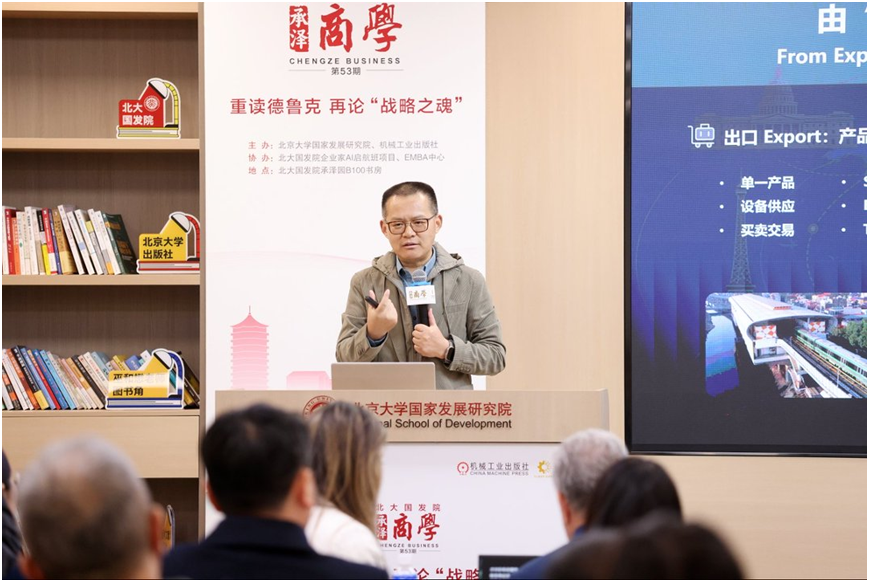
As one of the invited entrepreneurs, Gao Chunhai, Chairman of Traintrol Technology, shared with the attending scholars and business leaders how his company, guided by Drucker’s management thinking, has strategically transitioned from “product export” to “brand globalization,” using the company’s global expansion as a case study.
01 Strategic Transition
From "export" to "going global": more than just trading, it's about co-existing and co-growing.
Gao Chunhai stated bluntly in his speech:"In the past, when Chinese enterprises went global, most of them only focused on 'exporting' — selling products and equipment. Once the deal was done, they left. As a result, their substitutability is very high."
True "going global" is not a one-off transaction, but rather a holistic system export, deep integration across the entire process, and a partnership based on co-creation and mutual benefit.
"Right now, over 90% of Chinese companies going global are actually forced to do so — there aren't that many opportunities left in the domestic market. But truly proactive globalization requires building brands and systems, so that overseas customers develop long-term reliance on you."
Traffic Control Technology (TCT) is precisely transitioning from "selling equipment" to an integrated output of technology, products, and services. In projects such as the Cat Linh–Ha Dong light rail in Hanoi, Vietnam, and the Sydney Metro West line in Australia, the company has moved from simple cooperation toward deep symbiosis.
02 Integration of ideas
When Drucker Encounters Eastern Wisdom: Shared Values as a Cross-Cultural Bridge
Traffic Control Technology has integrated Drucker's management philosophy with Eastern wisdom to develop its PMV & CV cultural system. This has been documented as a case study in the book When Drucker Meets Confucius, earning international recognition.
Gao Chunhai shared a telling story: during negotiations for an international project, the two sides had reached an impasse over pricing. In the end, the client's decision-maker — having deeply resonated with the values and corporate culture that Traffic Control Technology had built upon Drucker's philosophy — proactively offered to raise the price appropriately, just to secure a long-term, stable, and trustworthy service guarantee.
"Your language may not be perfect, and legal terms can be negotiated. But when your vision, values, and ways of thinking are aligned, only then can you truly have a conversation on the same level. That is the most critical element in cross-cultural cooperation."
03 Long-termism
Steer clear of price wars, and become a long-term "guardian" navigating the future for your customers.
Gao Chunhai said that Chinese enterprises overseas are most prone to falling into homogenized, low-price cutthroat competition. "You start doing something today, and tomorrow ten others follow, offering prices only one-third or one-quarter of yours."
Following Drucker's philosophy, Traffic Control Technology adheres to market orientation and customer centricity, pursuing a differentiated path of technology + products + services. Instead of competing on low prices, it competes on long-term value.
Rail transit projects have life cycles spanning decades. What customers need is not a one-off deal, but a reliable partner that can stand by them for decades to come.
"Overseas customers choose us not because we are the cheapest, but because they trust that we will stay with them to solve problems along the way." Traffic Control Technology has established research centers with partners such as MTR Corporation, upgrading the "buyer-seller relationship" into a strategic partnership ofco-creation, symbiosis, and long-term accompaniment. Drucker's philosophy has helped us grasp the essence and achieve steady, sustainable progress in a complex international environment.
Looking ahead, Traffic Control Technology will continue to uphold technological independence, brand leadership, and long-term partnership, striving to become a global partner that exports technology, brand, and sustainable cooperation models. Its practice proves that the true foundation of globalization lies in shared values, long-termism, and deep symbiosis.


+852-60606742

TCT Building, No.3 Zhicheng North Street, Fengtai District, Beijing 京ICP备11000314号 京ICP备11000314号-1