
As the scale of urban rail transit networks continues to expand, a wide variety of equipment types, rigid system barriers, and isolated data silos are becoming common challenges troubling the industry. "Scheduled maintenance" leads to over-maintenance and ineffective maintenance, while "fault-based maintenance" triggers the risk of operational interruption. O&M personnel are run ragged, yet management finds it difficult to grasp the true health status of equipment.
Facing this common industry challenge, Guangxi Traffic Control Zhiwei Technology Development Co., Ltd., a controlled subsidiary of Traffic Control Technology, has specially created the Signal Intelligent Analysis System for rail transit O&M. We do not merely provide software; we provide a full-lifecycle O&M solution that transforms from "passive emergency response" to "proactive intelligent maintenance," helping to achieve the strategic goals of zero safety accidents, low O&M costs, and high management efficiency.
Safety as the Foundation: Moving from "Passive Emergency Repair" to "Proactive Intelligent Maintenance" to Build an Absolute Safety Defense Line
Safety is an insurmountable bottom line for rail transit. Through multi-source data fusion, the Signal Intelligent Analysis System builds a full-process closed loop of "monitoring—analysis—decision-making—execution," achieving two core breakthroughs:
Intelligent Risk Warning: By introducing proprietary algorithms, it proactively captures potential hidden dangers such as performance degradation before equipment failure, achieving "preventive treatment" and eliminating safety risks in the bud.
Precise Health Profiling: It builds equipment health models and outputs quantified "health scores," assisting O&M personnel in quickly locating the root causes of faults and providing solid technical backing for every safe journey.
Cost Reduction and Efficiency Improvement: Quantifying O&M Benefits and Rejecting Ineffective "Scheduled Maintenance"
In response to the industry's urgent need to reduce costs and increase efficiency, the Signal Intelligent Analysis System replaces traditional experience dependence with data-driven decision-making, achieving two core benefits:
Lower O&M Costs: Through precise "condition-based maintenance" recommendations, it effectively avoids over-maintenance and ineffective spare parts replacement, extends equipment lifespan, and maximizes the value of O&M funds.
Improved Handling Efficiency: Relying on multi-dimensional data correlation analysis to achieve precise fault localization, it greatly shortens fault diagnosis and repair time and significantly improves overall line operational efficiency.
Smooth Upgrade: Breaking Data Silos and Maximizing the Value of Existing Assets
In response to the practical concerns of mixed equipment brands, long service years, and reluctance to make repeated investments, the Signal Intelligent Analysis System features strong compatibility and openness.
Cost-Effective Legacy Reuse Solution: It supports non-intrusive access to existing monitoring data, breaking data silos without the need for large-scale hardware replacement, and achieving an intelligent leap in the O&M system at extremely low marginal cost.
Proven in Practice: Value Realized in Real-World Scenarios
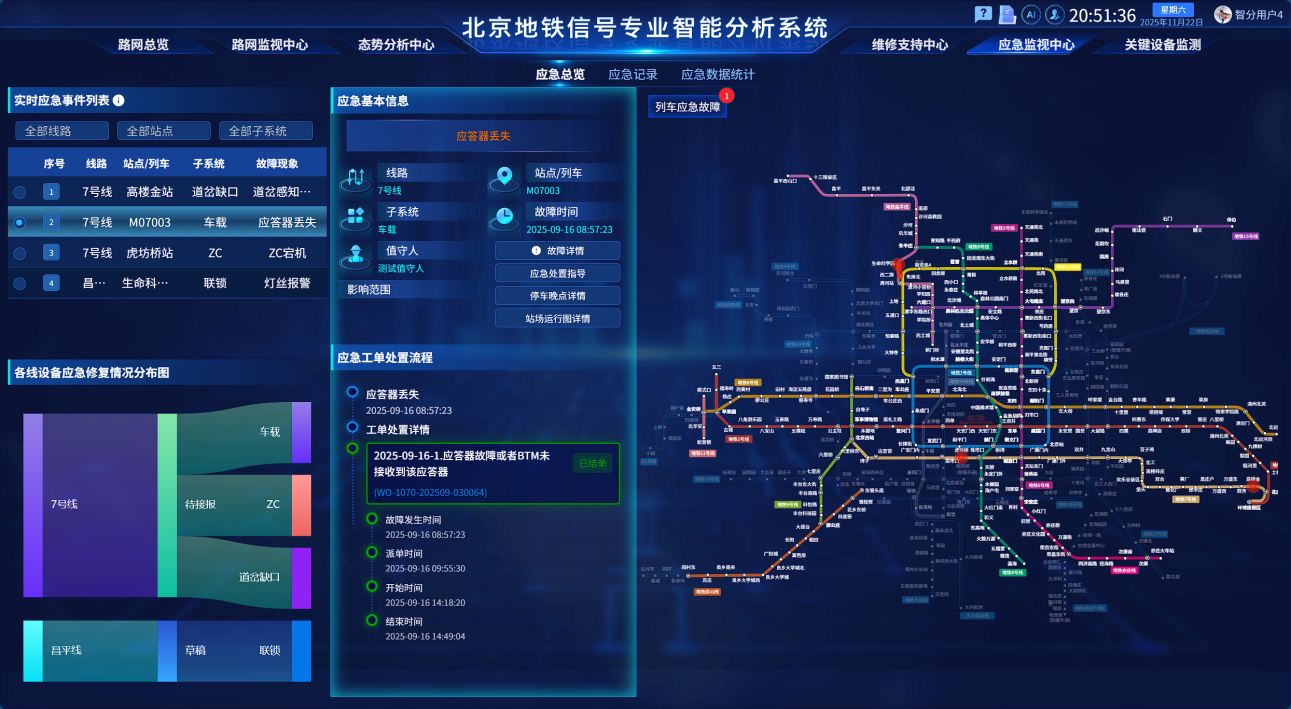
At present, the Signal Intelligent Analysis System has been successfully deployed on 7 lines of Beijing Subway: Line 1-Batong Line, Line 6, Line 7, Line 9, Line 11, Fangshan Line, and Changping Line. The system comprehensively collects massive monitoring data from the switch perception monitoring system and maintenance support subsystems of multiple lines, establishing powerful network-level intelligent O&M functions:
More Composed Emergency Response: Fault diagnosis time is greatly shortened, emergency command capability is significantly strengthened, and the goal of "knowing the situation clearly and having strategies at hand" is truly achieved.
More Flexible O&M Model: It has successfully promoted multiple lines to leap from "rigid scheduled maintenance" to "flexible condition-based maintenance," with comprehensive optimization of maintenance strategies.
More Transparent Management Closed Loop: Through work order closed-loop management, it ensures that fault handling processes are traceable and controllable, providing real and reliable data support for owners' long-term operational decisions.
In the future, the company will continue to deepen the intelligence level of the Signal Intelligent Analysis System, committed to advancing the O&M model from "intelligent assistance" to "autonomous decision-making." With independent and controllable core technologies as the cornerstone, we will continue to provide 7x24 dedicated O&M support and algorithm iteration services, helping the signal system achieve a dual leap in safety and efficiency amid the broad opportunities of urban rail intelligent transformation.


+852-60606742

TCT Building, No.3 Zhicheng North Street, Fengtai District, Beijing 京ICP备11000314号 京ICP备11000314号-1